The Fourth Gospel: Tales of a Jewish Mystic by Bishop John Shelby Spong
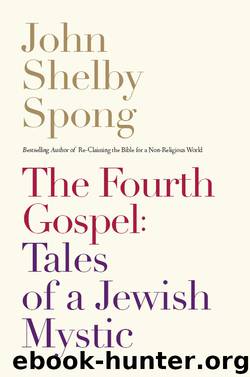
Author:Bishop John Shelby Spong [Spong, Bishop John Shelby]
Language: eng
Format: epub
ISBN: 9780062198167
Publisher: HarperCollins Publishers Australia
Published: 2013-03-10T13:00:00+00:00
CHAPTER 18
Not Atonement, but Glory! John Clarifies Jesus’ Death
As we begin to immerse ourselves into the Farewell Discourses, it is important to keep in mind that the Jesus of history never said any of the words attributed to him in these discourses, nor did he utter any of the teachings found in them.
These discourses, rather, represent an interpretation of the meaning of the death of Jesus from a vantage point in history years after the time of the crucifixion. They are the product of a community that had undergone two deep and transformative divisions: the separation from the synagogue to which I have previously referred and the fracture within the Johannine community itself over how to understand the relationship between God and Jesus.
The second split caused some of Jesus’ followers to feel so threatened that they began to find their way back to the synagogue. They could not journey to the new place to which this community was now walking. When this second separation was complete, the remaining members were free to move without impediment toward a new understanding of Jesus. This was, I believe, when the Christological debate began to take on universal and mystical connotations and the author of this gospel began to turn his writing in a very different direction.
There is in John no hint of what later came to be called the “doctrine of atonement.” That doctrine was the emphasis marking the writings of Paul, especially the early Paul, and it found expression in the synoptic tradition, but is absent from the Fourth Gospel. Paul was obsessed with human evil. He felt himself captured by its power. In order to understand how very different John’s interpretation is, we need to review how the doctrine of the atonement was formulated.
Paul portrays Jesus as the one who has the power to deliver human life from the depths of the sin by which it has been captured. When Paul relates the story of the crucifixion, he does so with the following words: “He died for our sins in accordance with the scriptures” (I Cor. 15:3). It is from this text that “Jesus died for my sins” was born. That expression was destined to become a mantra in Protestant and evangelical circles. This same theme is expressed by Roman Catholics when they refer to the Eucharist as “the sacrifice of the mass,” an expression which means that the mass is a liturgical reenactment of the moment when “Jesus died for my sins.” In both of these phrases the connection is expressed that the death of Jesus was the action that brought salvation or redemption to sinful human beings. God in the person of Jesus, and especially through his death, restored creation to its intended perfection. Jesus restored human life to oneness with God.
Primarily under the influence of a late-fourth-century theologian and bishop named Augustine, but continuing in history through Anselm in the twelfth century, to both Luther and Calvin in the sixteenth century, atonement theology has dominated Christian thought. Not
Download
This site does not store any files on its server. We only index and link to content provided by other sites. Please contact the content providers to delete copyright contents if any and email us, we'll remove relevant links or contents immediately.
Professional Troublemaker by Luvvie Ajayi Jones(29644)
Empire of the Sikhs by Patwant Singh(23069)
Twilight of the Idols With the Antichrist and Ecce Homo by Friedrich Nietzsche(18617)
Plagued by Fire by Paul Hendrickson(17400)
The Sun and Her Flowers by Rupi Kaur(14506)
Norse Mythology by Gaiman Neil(13332)
A Journey Through Charms and Defence Against the Dark Arts (Harry Potter: A Journey Throughâ¦) by Pottermore Publishing(9267)
Fangirl by Rainbow Rowell(9225)
Adultolescence by Gabbie Hanna(8909)
Wonder by R.J. Palacio(8567)
Tools of Titans by Timothy Ferriss(8360)
Becoming Supernatural by Dr. Joe Dispenza(8195)
How to Bang a Billionaire by Alexis Hall(8139)
Wonder by R. J. Palacio(8097)
Crystal Healing for Women by Mariah K. Lyons(7921)
The Road Less Traveled by M. Scott Peck(7590)
The Lost Art of Listening by Michael P. Nichols(7486)
The Witchcraft of Salem Village by Shirley Jackson(7249)
The Institute by Stephen King(7022)
